A fidelity that does not tremble
“Lord, increase my faith.” (MMA 2nd June 1837)
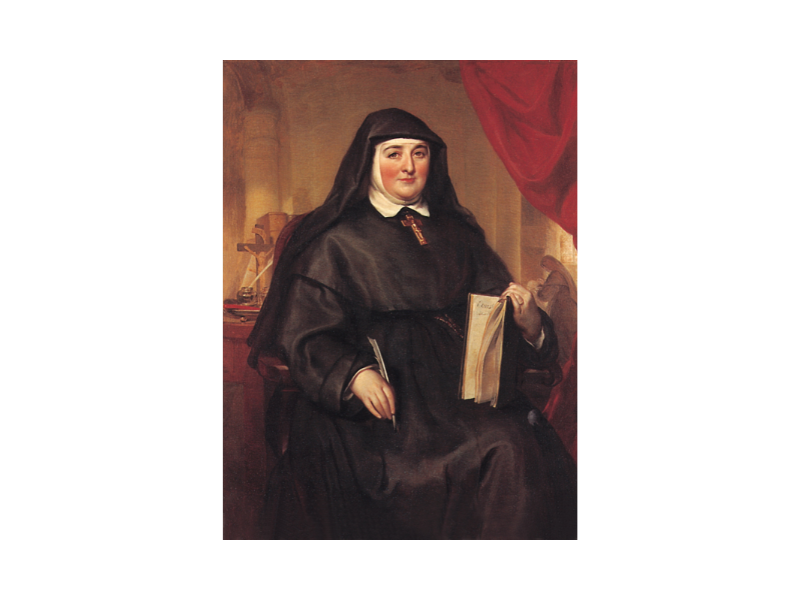
It was not a whisper among many, but the cry of one who knows their poverty before the mystery. In that frozen summer of 1837, Mary Aikenhead entrusted to these words of Saint Peter her entire life, the mission she had received, and the young Congregation she had seen born, grow, and struggle.
Once again, the earth had remained silent to the labor of the poor, and the harvest had withered before it could bloom. For the second consecutive year, the potato crop—the only food for many—was lost. The summer, cold and hostile, had buried all hope beneath frost. And the future looked bleak. In the most fragile homes, hunger began knocking even before autumn arrived. The Sisters of Charity shared the little they had, but knew it would soon no longer be enough. The Eucharist was strength and refuge. Their hands served, but their hearts were consumed in offering.
Mary had learned that not everything that grows is a sign of life, and not everything that blossoms conforms to the Spirit. There was a discernment to be preserved—more refined than judgment, more demanding than rigor: one that leads to recognizing what comes from God and what contradicts Him, even under radiant appearances.
The history of the Irish Church, slowly emerging from the shadows, reminded her that true resurrection never happens without a tomb. The heavy stones of repression were being lifted. The recent Catholic Emancipation, obtained in 1829 due mainly to the efforts of her friend Daniel O’Connell, had made possible what once was unthinkable: to consecrate cathedrals, to celebrate freely, to speak without fear. In Tuam and Derry, two new cathedrals had just been dedicated that very year. Signs of an awakening.
But Mary knew that visibility is no guarantee of authenticity. That every time the Church steps into the world, she must root herself even more deeply in grace. The same was true for her Congregation.
And right there, at the heart of community life, something had begun to fracture. A subtle unease, a hidden unrest. Some choices, particularly in the area of Novitiate formation, revealed a certain distance from the original spirit: direct service to the poor was beginning to be viewed by some as overly exposed, almost unsuitable for those who saw Religious Life as a vocation to be lived in more composed and reserved forms. Consecrated life risked being seen as a respectable shelter, rather than a total, humble, and joyful gift of self.
Mary suffered deeply. She perceived that what was at stake was not just a practice, but the very heart of the Charism she had received. And precisely where she had placed her greatest trust, she now sensed a different vision emerging—one that could not be accepted without compromising the spirit of the Congregation. Her insights were not born of rigidity, but of a radical and vigilant fidelity: the kind that recognizes the Spirit where everything is given, without measure.
A sense of disorientation among the younger sisters began to emerge, and Mary, with her habitual interior clarity, understood that the time had come to act. This was not about reacting to a passing difficulty, but about responding clearly to what was challenging the deepest identity of the Charism. With humility and pain, she turned to the counsel of Archbishop Daniel Murray, whom she recognized as the spiritual father of the Congregation.
The path he indicated was not easy to embrace, but Mary chose to follow it with obedience and interior freedom. Not to preserve a work, but to remain faithful to the spirit that had given it life. Not to protect an apparent imbalance, but to safeguard the received Gift in truth. She acted without fanfare, with the discreet strength of one who knows that every purification, if lived in faith, becomes a path of renewal.
It was then that her prayer became more bare, more essential, more fervent: “Lord, increase my faith”. She did not speak it to seek comfort, but to remain steadfast—even in the solitude of responsibility. She confided it to Mother Mary de Chantal and passed it on to her sisters as an invocation to be repeated in times of trial. In hiddenness, a fidelity that did not tremble was being consumed—because it rested entirely on the rock of God’s will.
Trials, in God’s design, do not break what He has planted: they prune it, nourish it in secret, so that it may bear fruit in due season. They are not punishments, but opportunities for truth. They are fire that burns away the dross, not the essence. So it was also for the Congregation. In that difficult time—full of silence and painful choices—the face of charity was marked by sincere tears, and in those tears, it regained its clarity.
The sisters who remained were not simply “the faithful”: they were the purified. Those who had chosen to remain not out of habit, but from conviction. Not for comfort, but out of love. They became more united, more true, more free. And that inner freedom—born of truth passed through —became the new ground where the Lord could sow once more.
The vocations that would come did not find a perfect community, but a community tilled by trial and made fruitful through obedience, — a community that had not avoided the cross, but had embraced it with discretion and trust. And it was from that cross, accepted but not displayed, that a new beginning bloomed.
Mary did not seek recognition. She knew that every true work inspired by the Spirit is not founded on visibility, but on hidden faithfulness. Every authentically evangelical foundation must remain rooted in God, like a seed entrusted to the earth: invisible to the eye, yet fruitful in the time of grace. While the Irish Church was being renewed in its visible temples, her Congregation was being renewed in what constituted its very soul: the spirit of the Gospel, lived in humility and charity. And the heart of Mary, in the silence of prayer and trial, offered everything to the Lord, so that He might bring to fruition what had been sown in faith.
Lord, increase my faith.
When numbers fall and judgment rises.
When fidelity becomes solitude.
When truth wounds.
When the charism must be guarded more than explained.
When structures are consolidated but the Spirit calls us back to the source.
When even today, as then, we are called to choose what is essential.
____________________________
REFLECTION POINTS
“No one who puts a hand to the plough and looks back is fit for the kingdom of God.” (Lk 9:62)
A stern word—but a true one. A word fulfilled every time someone, in trial, chooses fidelity over compromise, truth over convenience, God’s will over their own comfort.
This month’s story places before us a faith that is not led by emotion but by the Spirit. A mature, watchful faith, able to bear the weight of difficult decisions without falling into bitterness. Mary Aikenhead did not stop at appearances: she was able to discern what, at the heart of her community, was in danger of drifting from the spirit received. And she did so not out of rigidity, but out of love. A love that knows how to protect.
Holiness, as the Gospel shows us, is built on rock—not on success or approval, but on hearing and putting the Word into practice (Mt 7:24). In this sense, the life of Mary Aikenhead is a living commentary on the Beatitudes: blessed are the pure of heart, blessed are those persecuted for the sake of righteousness, blessed are the peacemakers. In her, everything passed through the test of the cross and the light. Everything became an offering, without display.
Even today, when tensions or fractures seem to touch the very heart of a community, the path is not fear nor control, but faith. A faith that begs the Lord to be strengthened: “Lord, increase my faith”
And in invoking, it already obeys.
There is no fruitfulness without purification.
There is no charism that is not also defended through suffering.
There is no evangelical life that can bloom without humility.
The holiness of Mary Aikenhead is not made of perfection, but of fidelity, of silence, of discernment, of a peace born of saying “yes” to the will of the Father—even when the heart is crossed by fear and the silence of solitude.
____________________________
PRAYER
Lord, increase our faith
Lord Jesus,
You who looked at Peter in his moment of doubt
and transformed his fall into greater love,
turn your gaze upon us
when we feel fragile and disoriented.
Lord, increase our faith,
when truth demands courage
and choices become lonely,
when remaining firm in your will feels like a loss.
Lord, increase our faith,
when we are tempted to defend the work
more than the gift received,
when the spirit of the world seduces us with worldly solutions,
restore to us the essential taste of the Gospel.
Lord, increase our faith,
when communion is strained
and obedience becomes a hidden offering,
when our decisions are not understood,
and silence and prayer are the only possible answers.
Lord, increase our faith,
when service to the poor
is no longer recognized as the royal way of the Gospel,
when the Charism becomes fragile
under the weight of misunderstanding and judgment,
lead our hearts back to the source.
Lord, increase our faith,
when loneliness envelops us
and everything in us wants to flee the cross,
when fidelity leads us down arid paths,
yet full of your hidden presence.
Lord, increase our faith,
when we understand that holiness
is not perfection, but perseverance,
not approval, but truth,
not success, but pure love.
Lord, increase our faith,
when, like Mary Aikenhead,
we find ourselves poor instruments in your hands,
yet still ready to say our yes.
Receive our small offering
and make it fruitful in Your love. Amen.
Dr Valentina Karakhanian
Postulator.
Phyllis Behan RSC
Vice-Postulator